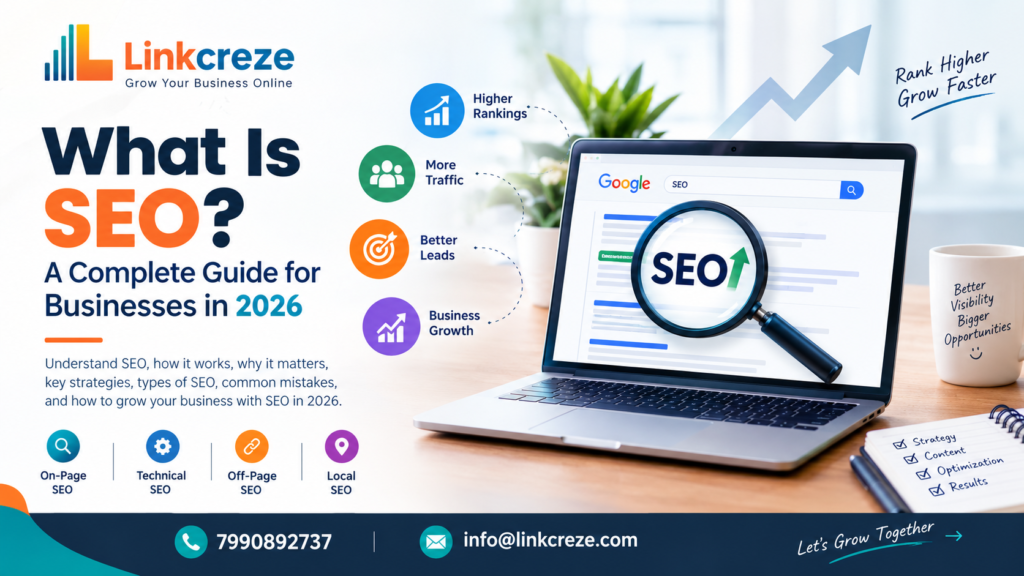
SEO (Search Engine Optimization) is one of the most important digital marketing strategies for businesses that want to build a strong online presence and attract potential customers through search engines.
When people need a product, service, company, restaurant, professional, or solution, they often search for it on Google. If your website appears in relevant search results, you have an opportunity to bring interested visitors to your business without paying for every click.
But SEO is much more than simply adding keywords to a website.
A successful SEO strategy involves improving your website, creating useful content, understanding what people are searching for, building trust and authority, improving the user experience, and making it easier for search engines to understand your business.
In this guide, we will explain what SEO is, how SEO works, why SEO matters for businesses, the major types of SEO, important SEO techniques, common mistakes, and how businesses can create a practical SEO strategy in 2026.
What Is SEO?
SEO stands for Search Engine Optimization.
It is the process of improving a website and its online presence so that search engines can better understand its content and users can find it when searching for relevant information, products, or services.
For example, imagine you own a digital marketing agency and someone searches:
“digital marketing company in Gujarat”
If your website is properly optimized and relevant to that search, your business may have an opportunity to appear in Google’s organic search results.
Unlike paid advertising, organic SEO does not require you to pay Google every time someone clicks your result.
However, SEO is not an instant marketing technique. It requires continuous optimization, useful content, technical improvements, authority building, and monitoring.
Why Is SEO Important for Businesses?
Having a website is not enough.
Your potential customers need to be able to discover your website when they search for products or services related to your business.
SEO can help businesses:
- Increase organic website traffic
- Improve search engine visibility
- Reach people actively searching for their products or services
- Generate relevant leads
- Build online credibility
- Improve website usability
- Support long-term digital growth
- Reduce dependence on paid advertising
- Increase opportunities for conversions
For example, a local business may optimize its website and Google Business Profile for searches related to its location and services. This can help the business become more visible to people searching nearby.
The real value of SEO comes from attracting relevant visitors, not simply increasing the number of visitors.
How Does SEO Work?
Search engines use complex systems to discover, understand, organize, and rank web pages.
Although search engines use sophisticated algorithms, businesses can improve their chances of appearing in relevant results by following SEO best practices.
A simple SEO process can be understood in four stages:
1. Crawling
Search engine crawlers discover pages across the web and access website content.
2. Indexing
Search engines analyze and store information about pages that they are able to process and index.
3. Understanding
Search engines try to understand the topic, purpose, quality, relevance, and context of a page.
4. Ranking
When someone performs a search, the search engine determines which results are most useful and relevant for that particular query.
This means SEO is not simply about “ranking a keyword.”
The goal is to create a website that provides a strong answer to the searcher’s need.
What Are the Main Types of SEO?
SEO can be divided into several important areas.
1. On-Page SEO
On-page SEO focuses on elements that exist on your website.
Common activities include:
- Keyword research
- Page titles
- Meta descriptions
- Heading structure
- Content optimization
- Internal linking
- Image optimization
- URL optimization
- Search intent optimization
- Content quality improvement
For example, if you have a page about SEO services, the content should clearly explain what services you provide, who they are for, what problems they solve, and how potential customers can contact you.
2. Technical SEO
Technical SEO focuses on the technical foundation of a website.
Important areas include:
- Website crawlability
- Indexability
- Mobile usability
- Website speed
- Core Web Vitals
- HTTPS
- XML sitemap
- Robots.txt
- Canonical URLs
- Redirect management
- Structured data
- Website architecture
A technically strong website makes it easier for search engines to access and understand your important pages.
Technical SEO is particularly important for larger websites, e-commerce stores, and websites with complex structures.
3. Off-Page SEO
Off-page SEO involves activities outside your website that can contribute to your website’s authority, reputation, and visibility.
Examples include:
- Quality backlinks
- Digital PR
- Business citations
- Relevant industry mentions
- Brand visibility
- Local references
- Relationship-based link building
The focus should be on earning relevant and trustworthy mentions rather than collecting a large number of low-quality backlinks.
4. Local SEO
Local SEO is designed to help businesses become more visible for location-based searches.
It is especially useful for:
- Restaurants
- Clinics
- Educational institutes
- Real estate companies
- Local service providers
- Retail stores
- Agencies
- Salons
- Professional services
Local SEO may involve optimizing your website, Google Business Profile, business information, local content, reviews, citations, and location-specific pages.
For example:
“SEO company in Vadodara”
has a different intent from:
“What is SEO?”
The first search has a stronger local and commercial intent, while the second is primarily informational.
Understanding this difference is important when developing an SEO strategy.
What Is Keyword Research?
Keyword research is the process of identifying the words and phrases people use when searching for information, products, or services.
For example, a digital marketing company might research keywords such as:
- SEO services
- SEO company
- local SEO services
- digital marketing services
- SEO services for small businesses
- SEO company in Gujarat
However, choosing keywords should not be based only on search volume.
A good keyword strategy considers:
- Search intent
- Business relevance
- Competition
- Potential value
- Location
- Customer needs
- Conversion potential
The best keyword is often the one that connects the searcher’s problem with your business solution.
What Is Search Intent?
Search intent refers to the reason behind a user’s search.
Understanding search intent is an important part of modern SEO.
There are several common types of search intent.
Informational Intent
The user wants to learn something.
Example:
“What is technical SEO?”
Navigational Intent
The user is looking for a particular website or brand.
Example:
“LinkCreze”
Commercial Intent
The user is researching options before making a decision.
Example:
“best SEO company for small business”
Transactional Intent
The user is ready to take an action, such as buying or contacting a business.
Example:
“SEO services for small business”
Your content should match the intent behind the keyword instead of trying to force the same type of page for every search.
SEO vs Paid Advertising
SEO and paid advertising can both help businesses generate visibility and leads, but they work differently.
SEO
- Builds organic visibility
- Can provide long-term value
- Requires ongoing optimization
- Does not charge for every organic click
- Takes time to build momentum
Paid Advertising
- Can generate traffic quickly
- Requires an advertising budget
- Allows precise campaign targeting
- Stops generating paid traffic when campaigns stop
- Useful for immediate promotional campaigns
For many businesses, SEO and paid advertising can work together.
Paid campaigns can help generate immediate traffic while SEO builds a stronger organic foundation over time.
How Long Does SEO Take?
One of the most common SEO questions is:
“How long does SEO take to work?”
There is no universal timeline.
Results depend on factors such as:
- Website history
- Competition
- Industry
- Existing website authority
- Technical condition
- Content quality
- Keyword difficulty
- Backlink profile
- Local competition
- SEO implementation
A new website competing for highly competitive keywords may require significantly more time and effort than an established website targeting specific, less competitive searches.
SEO should therefore be treated as a long-term growth strategy, rather than a short-term ranking shortcut.
Important SEO Strategies for Businesses in 2026
SEO continues to evolve, so businesses should focus on building a genuinely useful online presence.
1. Create Helpful Content
Write content that solves real customer problems.
Avoid creating articles simply because a keyword has search volume.
Ask:
Does this page genuinely help the person who searched for this topic?
2. Understand Your Audience
Before creating content, identify:
- Who your customers are
- What problems they have
- What they search for
- What information they need
- What prevents them from purchasing
- What questions they commonly ask
This helps create content that supports the entire customer journey.
3. Optimize Important Website Pages
Your main service and product pages should clearly communicate:
- What you offer
- Who you serve
- Why your service matters
- Your expertise
- Benefits
- Relevant information
- How customers can contact you
Do not rely entirely on blog content. Your commercial pages are often the pages most directly connected to business enquiries.
4. Build Strong Internal Links
Internal links connect one page of your website to another.
For example, a blog about:
“What Is SEO?”
could naturally link to:
SEO Services
and then to:
Contact Us
Internal linking helps users discover related content and can help search engines understand the relationship between pages on your website.
5. Improve Website Experience
A website should be easy to use on both desktop and mobile devices.
Pay attention to:
- Page loading performance
- Mobile usability
- Navigation
- Readability
- Clear calls to action
- Secure browsing
- Logical page structure
A visitor should quickly understand what your business does and what they can do next.
6. Strengthen Local Visibility
If your business serves a specific geographic area, local SEO can be an important part of your strategy.
Maintain accurate business information and create useful location-relevant content instead of creating low-value pages simply to target different city names.
Common SEO Mistakes Businesses Should Avoid
Many businesses invest time in SEO but make mistakes that limit their results.
Keyword Stuffing
Repeating the same keyword excessively can make content difficult to read and does not create a better user experience.
Copying Content
Publishing copied or lightly rewritten content can weaken the value of your website.
Create content based on your own expertise, research, examples, customer questions, and experience.
Buying Low-Quality Backlinks
A large number of irrelevant or manipulative links is not a sustainable SEO strategy.
Ignoring Technical SEO
Excellent content cannot reach its full potential if important pages cannot be properly crawled or indexed.
Creating Content Without Search Intent
A page may target the right keyword but still fail if it does not satisfy what the searcher actually wants.
Focusing Only on Rankings
Rankings are useful, but businesses should also track:
- Organic traffic
- Qualified leads
- Engagement
- Conversions
- Revenue opportunities
The ultimate objective is business growth, not just a position in a search result.
How to Create an SEO Strategy for Your Business
A practical SEO strategy can follow these steps:
Step 1: Understand Your Business
Identify your services, products, target customers, locations, and competitive advantages.
Step 2: Analyze Your Existing Website
Review technical SEO, content, website structure, page performance, indexing, and user experience.
Step 3: Research Keywords
Identify relevant keywords based on customer needs and search intent.
Step 4: Prioritize Pages
Decide which service, product, location, and informational pages should be optimized first.
Step 5: Improve Existing Content
Update outdated or weak pages instead of creating new content for every topic.
Step 6: Create Useful New Content
Publish original articles that answer genuine customer questions and support your main services.
Step 7: Build Authority
Work on legitimate opportunities for relevant mentions, links, partnerships, and digital PR.
Step 8: Monitor Performance
Track organic visibility, traffic, leads, conversions, and important technical issues.
Step 9: Keep Improving
SEO is an ongoing process. Search behavior, competition, websites, and search engine systems continue to change.
How Can SEO Help Generate Leads?
SEO becomes more valuable when website traffic is connected to a clear conversion path.
For example:
Google Search → SEO Blog → Service Page → Contact Form → Business Enquiry
A business can support this journey with:
- Clear service pages
- Relevant internal links
- Strong calls to action
- Contact forms
- WhatsApp/contact options
- Case studies
- Trust signals
- Helpful FAQs
The objective is not simply to attract more visitors. It is to attract the right visitors and make it easy for them to take the next step.
Is SEO Still Important in 2026?
Yes, SEO remains important, but the way businesses approach it should continue to evolve.
Search is becoming more complex, with users discovering information through traditional search results, local results, AI-powered search experiences, videos, social platforms, maps, and other digital channels.
This means businesses should not build their SEO strategy around one ranking position or one keyword.
Instead, focus on:
Useful content + strong website experience + relevant visibility + credibility + clear business value.
A business that consistently provides useful information and a trustworthy online experience has a stronger foundation for long-term organic growth.
Frequently Asked Questions About SEO
What does SEO stand for?
SEO stands for Search Engine Optimization. It is the practice of improving a website and its online presence to increase visibility for relevant searches.
Is SEO free?
Organic search results do not require businesses to pay for every click. However, effective SEO requires time, expertise, tools, content creation, technical work, and ongoing optimization.
Can SEO increase website traffic?
Yes. A successful SEO strategy can increase relevant organic traffic by improving visibility for searches related to your business.
Can SEO generate leads?
Yes. SEO can generate leads when it attracts relevant potential customers and connects them with well-optimized service or product pages and clear conversion opportunities.
Is SEO suitable for small businesses?
Yes. SEO can be particularly useful for small businesses because it can help them compete for relevant searches, especially when they focus on specific services, audiences, and locations.
Should I focus on SEO or Google Ads?
It depends on your business objectives. SEO is generally focused on building long-term organic visibility, while Google Ads can provide faster paid visibility. In many cases, combining both strategies can be effective.
Final Thoughts
SEO is not simply about getting a website to appear higher on Google.
It is about helping the right people discover useful information, understand your business, trust your brand, and take meaningful action.
For businesses in 2026, a strong SEO strategy should combine technical optimization, useful content, search intent, keyword research, local visibility, internal linking, website experience, authority building, and continuous measurement.
The businesses that approach SEO as a long-term investment rather than a quick ranking trick are better positioned to build sustainable online visibility.
If your business wants to improve its organic visibility, attract more relevant website visitors, and create a stronger search presence, a professional SEO strategy can provide a structured starting point.
Ready to Improve Your Online Visibility?
LinkCreze helps businesses build practical digital marketing and SEO strategies focused on visibility, relevant traffic, and lead generation.
Explore our SEO services to learn how we can help improve your website’s search visibility and online presence.
Start with an SEO audit and identify the opportunities your website can improve.